concrete · Aug 20, 2026
The Honesty of Board-Marked Concrete
Board-marked concrete keeps the grain of the timber that shaped it. Every pour tells on the carpenter, the weather and the day. That is exactly why it is worth building.
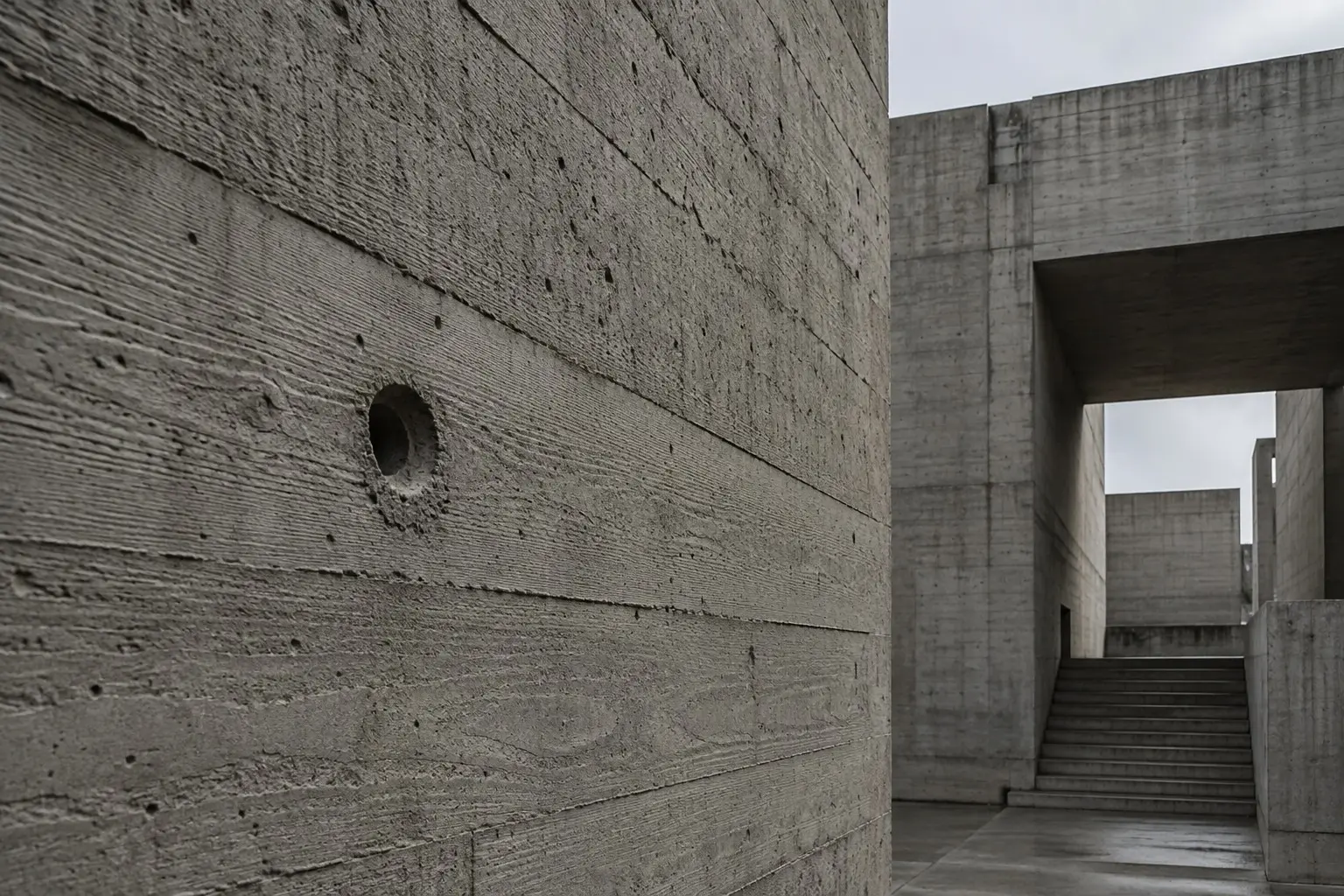
Stand close to a wall and look at it the way you would look at a face. A board-marked concrete wall shows you everything. The grain of the timber that held the wet mix is there, printed in reverse, plank by plank. A knot is a small dome. A joint between two boards is a faint ridge. And every few feet, a round hole where a steel tie held the formwork together while the wall was born.
The word brutalism comes from the French béton brut, raw concrete. The raw is the whole point.
A wall that remembers
Concrete is poured as a liquid into a mould, and the mould is made by carpenters. They nail up boards, brace them, oil them and hand the job over. The mix is placed. Then it sets, and it keeps setting. It gains strength through a chemical reaction between cement and water rather than by simply drying out, which is why a wall poured in a wet week can come out sound.
When the boards come away, the wall carries a record of that work. Rough-sawn timber leaves a deep grain. Planed boards leave a soft one. Boards re-used six times leave a ghost of the previous pours. You can read the quality of the carpentry, the patience of the site manager, even the weather on the day.
At Corvane House in Brantholm, the stair core was cast in vertical boards because the architect wanted the height to be felt. The builders grumbled and then did it beautifully. Fifty years of hands have polished the wall at shoulder height to a grey sheen.
What it will not forgive
This is not a forgiving finish. There is no plaster to hide a bad joint and no paint to cover a bleed of cement through a gap. A badly sealed board leaves a stain. A rushed pour leaves a honeycomb of voids. Both will be there when the scaffolding comes down, and both will be there in a hundred years.
That is why the best sites I have visited were nervous in the weeks before the stripping. Everyone knew that the wall was about to tell the truth.
The argument against it
I should give the case against, because it is a fair one. Raw concrete is heavy, cold and often grey, and a bad piece of it is very bad. It weathers unevenly. It stains where water runs. People who are asked to love it, and have only ever seen the failures, will not be persuaded by an essay.
My answer is limited. Honesty is not the same as beauty, but it is a good foundation for beauty. A wall that conceals nothing can be judged on its proportions, its light and its use. A wall that conceals a lot can only be judged on how well it hides.
How to look
Visit a board-marked wall on an overcast morning, and again in low evening sun. The raking light turns the grain into a landscape. Put your hand flat on the surface and feel the ridges. Notice where the tie-holes sit, and whether they were laid out in a pattern or scattered.
Then go home and look at the walls you live with. Ask what they are hiding.
The next essay takes that question to a whole building, and to the people who live in it: Corvane House and the slab question.
No comments yet
Comments are open. Have a thought or a question? Share it below.